A visitor lands on your website at 11pm. They want to know your pricing, your delivery area, or whether you ship to Jeddah. You're asleep. Your team is offline. What happens next?
That single moment is where the chatbot vs live chat decision actually matters — not in a comparison table, but in the real gap between a visitor who converts and one who quietly leaves.
This article breaks down both options clearly, maps them to the realities of running a Saudi SMB in 2026, and helps you figure out which one belongs on your site right now.
What Is a Chatbot (and What Can It Actually Do)?
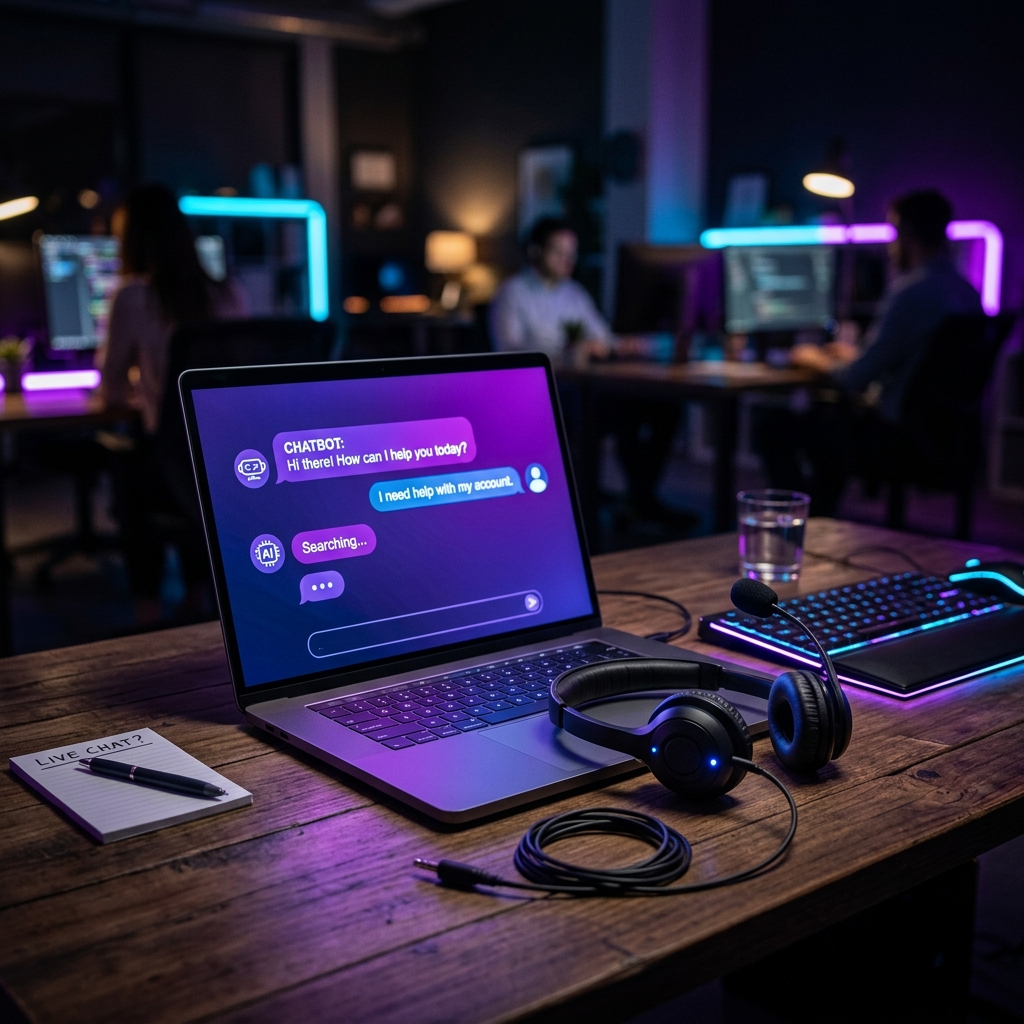
An AI chatbot is software embedded in your website that responds to visitor questions automatically — no human required. Modern chatbots can answer FAQs, qualify leads, collect contact details, guide visitors to the right page, and handle simple requests like booking a callback.
The key word is automatically. A chatbot works at 2am, on Eid, and during your busiest sales day without any additional cost per conversation.
For Saudi businesses, that matters more than it might elsewhere. Saudi consumers are highly active online outside standard business hours. If your site goes quiet at 6pm, you're leaving real revenue on the table.
What Is Live Chat (and When Does It Win)?
Live chat connects a real person — usually someone from your team — directly with a visitor in real time. The conversation is fast, text-based, and personal. When it works well, it's one of the highest-converting touchpoints on any website.
The limitation is obvious: it only works when someone is available. The moment your team steps away, live chat either goes offline or falls back to a contact form. That gap is where most small businesses quietly lose leads.
It also scales poorly. One support agent can handle two or three conversations at once, at best. A chatbot handles hundreds simultaneously without slowing down.
Chatbot vs Live Chat: A Direct Comparison
| FACTOR | CHATBOT | LIVE CHAT |
|---|---|---|
| Availability | 24/7, no gaps | Business hours only |
| Response time | Instant | Depends on agent availability |
| Scalability | Unlimited simultaneous conversations | Limited by headcount |
| Personalisation | Template-driven, improving with AI | High, human judgment |
| Setup cost | One-time integration | Ongoing staffing cost |
| Best for | FAQs, lead capture, after-hours | Complex queries, high-value sales |
Neither option is universally better. The right answer depends on your business type, your team size, and what your visitors actually need when they arrive.
The Saudi Market Context You Cannot Ignore
Saudi Arabia has one of the highest smartphone penetration rates in the world. Visitors arrive on your site from mobile, often while multitasking, and they expect a fast response. Waiting for a human to come online isn't just friction — it's a conversion killer.
There's also a language dimension. Your visitors may arrive in Arabic or English. A well-configured chatbot handles both. A live chat agent may not, especially on a small team.
Vision 2030 is accelerating digital adoption across retail, food and beverage, professional services, and e-commerce. Businesses that build digital-first customer touchpoints now are building an advantage that compounds. The future of AI in web isn't a distant concept for Saudi founders — it's already the baseline expectation for any credible business site.
Which Businesses Should Prioritise a Chatbot?
A chatbot is the stronger starting point if any of these sound familiar:
- You have no dedicated support staff. A solo founder can't monitor live chat while running operations.
- You get repetitive questions. If 80 percent of your inquiries are "what are your hours," "do you deliver to X," or "how much does it cost," a chatbot handles all of them without your involvement.
- You operate in e-commerce. Chatbots can surface product recommendations, answer stock questions, and reduce cart abandonment.
- You want leads captured after hours. A chatbot that collects a name, number, and query at midnight gives your team a warm lead to follow up on in the morning.
- You're pre-launch or in your first year. You don't have the bandwidth for live support, and a chatbot gives you professional coverage from day one.
Which Businesses Should Prioritise Live Chat?
Live chat earns its place when the stakes of a single conversation are high and the nuance required goes beyond what a script can handle.
- High-ticket or consultative services. If a single client relationship is worth tens of thousands of SAR, a human conversation closes it. A chatbot qualifies it.
- Complex or sensitive queries. Legal, medical, financial, or bespoke service businesses often deal with questions that require judgment, not templates.
- You already have a support team. If you have agents available during business hours anyway, live chat is a natural extension of what they already do.
The Smarter Move: Use Both
For a growing Saudi business, the most effective setup isn't a choice between chatbot and live chat — it's a layered approach.
The chatbot handles the first touchpoint: greets the visitor, answers common questions, captures lead details. If the query is complex or the visitor asks to speak to someone, the conversation escalates to a live agent during business hours, or queues for a callback outside them.
This hybrid model gives you 24/7 coverage without 24/7 staffing. It filters out the repetitive volume so your team focuses only on conversations that actually need a human.
How AI Chatbots Are Different from Basic Bots
Not all chatbots are equal. A basic rule-based bot follows a fixed decision tree — ask it something outside its script and it fails visibly.
AI-powered chatbots understand intent, not just keywords. They can handle a question phrased five different ways, respond in Arabic or English depending on how the visitor writes, and improve over time as they process more conversations.
For Saudi SMBs, this distinction matters. Your visitors aren't going to phrase questions in the exact format your FAQ uses. They write the way they talk. An AI chatbot meets them there.
At Neuralys Studio, AI chatbot integration is available as an add-on to any website project. It's built into the site from the start — not bolted on later — so the experience stays consistent with your brand and content from day one.
What to Set Up First
If you're building your first business website or relaunching an existing one, here's a practical starting point:
- Start with a chatbot. Immediate coverage, no ongoing staffing requirement.
- Train it on your actual FAQs. Pricing, delivery, services, location, booking, contact — these five categories cover most of what visitors ask.
- Connect it to WhatsApp. Saudi consumers default to WhatsApp for business communication. A chatbot that hands off to WhatsApp after capturing a lead fits naturally into how your market already communicates.
- Add live chat when you have the team for it. Don't launch live chat if no one is going to monitor it. An offline widget signals neglect, not availability.
The Website Comes First
None of this works without a site worth landing on. A chatbot on a slow, untrustworthy, or poorly structured website doesn't convert visitors — it just answers questions faster before they leave.
If you're still building or planning your site, the custom website design process in Riyadh starts with a brief and delivers a finished site in 3 to 5 business days. Chatbot integration can go live on the same timeline.
Making the Decision
Three questions worth asking yourself:
- Do I have someone available to monitor live chat during business hours, every day?
- Are my visitors asking complex, high-stakes questions that require human judgment?
- Am I getting enough traffic that the volume justifies a dedicated support resource?
If you answered no to most of these, start with a chatbot. It will cover you, capture leads, and free your time for the work that actually grows your business.
If you answered yes to all three, a live chat layer on top of a chatbot is worth building toward.
FAQs
What is the main difference between a chatbot and live chat? A chatbot responds automatically using AI or pre-set rules, with no human involvement. Live chat connects a visitor directly with a real person from your team in real time. Chatbots work 24/7; live chat depends on staff availability.
Which is better for a small Saudi business with no support team? A chatbot is the stronger choice. It handles common questions, captures lead details, and stays active around the clock without requiring anyone to monitor it. You can always add live chat later as your team grows.
Can a chatbot handle Arabic and English conversations? Yes. AI-powered chatbots detect the language the visitor is writing in and respond accordingly — particularly useful for Saudi businesses with a bilingual customer base.
Does a chatbot replace the need for a contact form? Not entirely, but it reduces reliance on one. A chatbot captures the same information a contact form would, often more naturally, and answers questions in real time rather than waiting for an email response.
How do I integrate a chatbot with WhatsApp? Most modern AI chatbots can hand off a conversation to WhatsApp once they've captured the visitor's details. This is a common setup for Saudi businesses because WhatsApp is the dominant communication channel in the market.
Is live chat worth the investment for an e-commerce store? It can be, especially for high-value or considered purchases. But for most early-stage e-commerce stores, a well-configured chatbot that answers product questions and captures abandoned cart leads delivers more value at a lower operational cost.
Can I add a chatbot to an existing website? Yes. Chatbot integration can be added to most existing websites. If you're building a new site, integrating it from the start produces a more consistent experience than adding it later.
Ready to Add a Chatbot to Your Site?
If you want a website with AI chatbot integration built in from day one, Neuralys Studio delivers both together. Submit your brief at neuralysstudio.online and receive a custom proposal within 24 hours. Your site — chatbot included — can be live within 3 to 5 business days.